

You may recognize the voice before you recognize the person. That is the strange power of a great voice artist. From the commanding voice of Bigg Boss and the Hindi versions of Hollywood blockbusters to the unmistakable announcements heard in metro stations and the familiar voices of television commercials, these performers have become part of everyday Indian life without always receiving the same attention as on-screen stars. Here are five Indian voice-over artists whose work stands out for reach, versatility, recognition and lasting impact in 2026.
Quick Summary
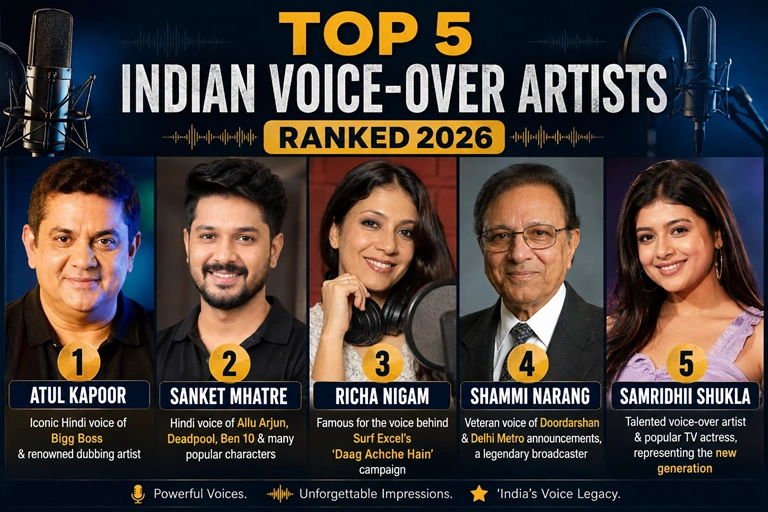
- Atul Kapoor — Best known as the iconic Hindi voice of Bigg Boss and for major dubbing work.
- Sanket Mhatre — A leading Hindi dubbing artist associated with Allu Arjun, Deadpool, Ben 10 and several major characters.
- Richa Nigam — Famous for the distinctive husky voice behind Surf Excel’s “Daag Achche Hain” campaign.
- Shammi Narang — A veteran broadcaster whose voice became synonymous with Doordarshan and metro announcements.
- Samridhii Shukla — A newer-generation voice artist who successfully moved from dubbing into mainstream television acting.
- This ranking is editorial rather than an official industry award ranking, based on recognizability, body of work, versatility, cultural reach and continued relevance.
How We Ranked India’s Top Voice-over Artists in 2026
There is no universally accepted annual ranking for Indian voice-over performers. That makes a list like this slightly different from ranking cricketers by runs or actors by box-office collections.
A successful voice artist can build a career in advertising, film dubbing, animation, television, radio, documentaries or public announcements. Some voices become famous because of a single character; others become recognizable precisely because audiences hear them in dozens of different situations.
For this ranking, the main factors are voice recognition, career longevity, versatility, major credits, cultural impact and relevance to Indian audiences in 2026.
That distinction matters. A voice artist does not need to be a celebrity in the conventional sense. In fact, some of the most effective performers have spent years working behind the microphone while the people on screen receive the applause.
1. Atul Kapoor
If recognition is the first test, Atul Kapoor has one of the strongest cases on this list.
Kapoor has been active as an actor and voice actor since 2002, but his defining association is the voice of Bigg Boss. He began voicing the reality show’s famous unseen authority in 2006, with the programme later continuing on Colors from 2008.
The remarkable part is how little the audience needs to hear before identifying him. The measured delivery, authoritative tone and deliberate pacing have become part of the show’s identity.
What makes Atul Kapoor stand out?
Kapoor’s career extends beyond reality television. He has worked extensively in Hindi dubbing for international content and has lent his voice to projects involving characters and performers from Hollywood productions. His credits include work connected with Cosmos: A Spacetime Odyssey, Loki and Marvel-related Hindi dubbing.
His voice has also been associated with J.A.R.V.I.S. and Vision in Hindi versions of Marvel films, adding another layer to an already recognizable career.
What makes him particularly interesting is the contrast between his work. The voice that can sound authoritative enough to control a reality-show house can also be adapted to entertainment, science programming and fictional characters.
2026 ranking: #1
Best known for: Bigg Boss, Hindi dubbing, international film and television voice work.
Why he ranks first: Exceptional mass recognition combined with long-term television presence and dubbing versatility.
2. Sanket Mhatre
Sanket Mhatre represents the modern Indian dubbing artist perhaps better than anyone on this list.
Born in Mumbai in 1988, Mhatre has built an extensive career in Hindi voice acting, working across animation, Hollywood films and South Indian cinema. IMDb identifies him as a Hindi dubbing specialist and credits him with work involving performers such as Allu Arjun, Mahesh Babu, Jr. NTR, Vijay and others.
His range is what makes his résumé particularly impressive.
From Ben 10 to Deadpool
Mhatre became widely recognized as the Hindi voice of Ben Tennyson in Ben 10: Alien Force, Ben 10: Ultimate Alien and Ben 10: Omniverse. He also dubbed Ryan Reynolds’ character Deadpool in Hindi.
Those roles require completely different approaches. Ben Tennyson is animated and youthful, while Deadpool depends heavily on comic timing, attitude and rapid dialogue delivery.
His portfolio does not stop there. Mhatre has also voiced characters in The Legend of Hanuman, including Shree Ram, and has worked on Hindi versions of several major international and Indian productions.
A 2023 interview profile highlighted his work as the Hindi voice associated with Allu Arjun and other South Indian stars, as well as roles in projects such as Deadpool, Captain America, The Martian and animated productions.
Why his work matters
Hindi dubbing has become a much bigger part of mainstream entertainment. Audiences now regularly consume South Indian films, anime, international series and Hollywood productions in Hindi.
Mhatre’s career sits directly at that intersection.
2026 ranking: #2
Best known for: Ben 10, Deadpool, Allu Arjun’s Hindi dubbing and major animation/dubbing projects.
Why he ranks second: Outstanding versatility and one of the strongest portfolios across animation, Hollywood and Indian cinema.
3. Richa Nigam
Richa Nigam proves that a voice does not have to be traditionally smooth or conventionally “perfect” to become memorable.
Her distinctive, grainy and husky delivery became strongly associated with advertising, particularly Hindustan Unilever’s Surf Excel “Daag Achche Hain” campaign. The Economic Times previously identified Nigam among India’s leading voice-over artists and noted her extensive commercial portfolio.
Her advertising work has included brands such as Tata Indicom, Tata Sky, Brooke Bond, Pillsbury, Nutrilite, Domino’s, ING Vysya and Coca-Cola.
Turning an unusual voice into a strength
Nigam’s story is especially useful for anyone interested in becoming a voice-over artist.
She was reportedly self-conscious about her voice because it did not fit the conventional singing voice she imagined she needed. Instead, that very quality became her professional advantage. Advertising depends heavily on recall, and a voice that sounds different can make a commercial easier to remember.
Industry commentary quoted by The Economic Times described her voice as one that cuts through the clutter and stays with audiences.
Her work has also extended beyond traditional advertising. Production credits have listed Richa Nigam as a voice artist on commercial projects, including an Ola Electric film.
That combination of advertising experience, writing ability and a highly recognizable vocal character gives her a particularly strong position among Hindi voice-over artists.
2026 ranking: #3
Best known for: Surf Excel, advertising voiceovers and her unmistakable husky delivery.
Why she ranks third: Few advertising voices have achieved the same combination of distinctiveness, brand association and longevity.
4. Shammi Narang
Before podcasts, streaming platforms and YouTube transformed audio entertainment, television newsreaders were among India’s most recognizable voices.
Shammi Narang was one of those voices.
A former Doordarshan newsreader and veteran voice-over artist, Narang became strongly associated with Hindi broadcasting during the 1970s and 1980s. He later became widely recognized for public-address and metro announcements.
The voice behind India’s public spaces
Narang’s voice is not confined to television archives.
His recorded Hindi announcements have been used across metro systems and public spaces, including Delhi Metro and other metro networks.
That gives his career an unusual dimension. A film dubbing artist might be heard for two or three hours during a movie. Narang’s voice can become part of someone’s daily commute.
His deep, controlled delivery became a model of authoritative Hindi broadcasting. A profile from Harmony India described his baritone as synonymous with Hindi news reading and noted that his voice could also be heard in places such as planetariums and metro systems.
His legacy was still being recognized in 2026. The Ministry of Culture’s Press Information Bureau reported his participation as a special guest at the January 2026 launch of Awaazon Ke Jugnu: The Voice Masters of India, a book and discussion programme celebrating India’s voice traditions.
2026 ranking: #4
Best known for: Doordarshan, broadcasting, metro announcements and his distinctive baritone.
Why he ranks fourth: His cultural reach and longevity are exceptional, particularly outside conventional film dubbing.
5. Samridhii Shukla
Samridhii Shukla brings a different story to this list: the transition from voice artist to mainstream television actor.
Shukla has worked as both an actress and dubbing artist. Her voice work includes Hindi dubbing projects, while her television career has included Saavi Ki Savaari and the highly visible role of Abhira Sharma Poddar in Yeh Rishta Kya Kehlata Hai.
From the recording booth to television
Her background in voice acting is particularly relevant because it shows how dubbing can become a training ground for broader performance.
An interview published by India Forums in 2025 described her early voice work as an important part of her development, with Shukla discussing how dubbing taught her control, expression and the ability to communicate emotion without relying on facial performance.
Her dubbing credits have included international and Indian productions. IMDb lists Hindi voice work connected with KPop Demon Hunters, The Boys and Ala Vaikunthapurramuloo, among other credits.
She has also been associated with the Hindi voice of Doraemon, having taken over the role in 2020 before later being replaced.
That combination makes her an interesting representative of the next generation of Indian voice performers. Unlike traditional voice artists who may remain largely anonymous, Shukla has developed a visible identity both behind and in front of the camera.
2026 ranking: #5
Best known for: Hindi dubbing, Doraemon voice work and television acting.
Why she ranks fifth: Strong crossover appeal and a growing profile, although her voice-over career is shorter than those of the veterans above.
What Makes These Five Indian Voice Artists Different?
Putting these artists together reveals something interesting: there is no single formula for a successful voice career.
Atul Kapoor built extraordinary recognition around one iconic television voice while developing a wider dubbing portfolio. Sanket Mhatre represents technical versatility across animation, Hollywood and Indian cinema. Richa Nigam made an unconventional vocal texture into a powerful advertising identity.
Shammi Narang demonstrates the lasting power of authoritative broadcasting, while Samridhii Shukla shows how voice acting can become a foundation for an on-camera career.
That is also why simply asking who has the “best” voice is not enough.
A good voice-over performance depends on character, diction, timing, emotional control, microphone technique and the ability to serve the material. A voice that works brilliantly for a children’s animation may be completely wrong for a documentary. Likewise, the warm tone that sells a family-oriented advertisement may not work for a superhero character.
The strongest artists know the difference.
Why Voice-over Artists Matter More Than Most Viewers Realize
The Indian entertainment market has become increasingly multilingual. Hindi versions of South Indian films, Hollywood releases, streaming series, anime, animated shows and documentaries have created more opportunities for dubbing professionals.
At the same time, advertising remains heavily dependent on recognizable voices.
Then there is the less glamorous but equally important world of public information: railway announcements, metro systems, museums, educational content, corporate films and IVR systems.
This means a voice artist’s work can reach an audience without the audience ever knowing their name.
That is precisely what makes the profession fascinating.
A person may forget who performed a character’s Hindi dialogue, but remember the voice for years.
Are Voice-over Artists the Same as Dubbing Artists?
Not exactly.
A voice-over artist records narration or spoken material where the voice typically exists independently of an on-screen character. Advertising narration, documentaries, corporate videos and announcements are common examples.
A dubbing artist, on the other hand, generally replaces or recreates the dialogue of a character from another language or production. Matching timing, emotion and performance becomes critical.
Some professionals do both.
Sanket Mhatre is a strong example because his career covers character dubbing, animation and Hindi versions of international and Indian productions. Richa Nigam’s career, meanwhile, is particularly associated with advertising voice-over work.
The distinction is useful when comparing careers because success in one area does not automatically mean success in another.
The Future of Indian Voice-over Work in 2026
The profession is changing quickly.
Streaming platforms have made multilingual content mainstream, while animation and gaming have created new character-voice opportunities. Advertising has also expanded from television into short-form digital video, social media and branded content.
At the same time, artificial intelligence and synthetic voices are creating legitimate questions about the future of professional voice acting.
Yet human performance still has an advantage when a project requires nuanced emotion, character interpretation, cultural context or a distinctive personality. A technically clear voice is not automatically a compelling one.
The careers of these five artists demonstrate why.
Whether it is Atul Kapoor’s authority, Sanket Mhatre’s character flexibility, Richa Nigam’s unmistakable texture, Shammi Narang’s commanding diction or Samridhii Shukla’s expressive range, the value lies in the personality behind the sound.
Frequently Asked Questions
Who is the most famous Indian voice-over artist in 2026?
Atul Kapoor is among the most recognizable Indian voice artists, largely because of his long-running association with the Hindi voice of Bigg Boss. His additional dubbing work strengthens his position.
Who is the Hindi voice of Deadpool in India?
Sanket Mhatre is widely associated with the Hindi dubbing voice of Ryan Reynolds’ Deadpool. His wider career includes animation, Hollywood films and Hindi dubbing for major South Indian actors.
Who is the voice behind Surf Excel’s “Daag Achche Hain”?
Richa Nigam is strongly associated with Surf Excel’s “Daag Achche Hain” advertising campaign. Her distinctive husky voice has also appeared in commercials for several major brands.
Who is the voice of Delhi Metro announcements?
Shammi Narang is widely known for recording Hindi announcements used by Delhi Metro and other public transport systems. His career also includes Doordarshan newsreading and extensive voice-over work.
Conclusion
The best Indian voice-over artists are not simply people with pleasant voices. They are performers who understand how to make words carry personality, emotion and authority.
Atul Kapoor leads this 2026 editorial ranking for sheer recognizability and cultural reach, while Sanket Mhatre stands out for extraordinary dubbing versatility. Richa Nigam’s advertising legacy, Shammi Narang’s broadcasting influence and Samridhii Shukla’s newer-generation crossover career complete a group that represents very different sides of India’s voice industry.
And perhaps that is the biggest lesson: a memorable voice does not need a face to become famous.